Ambe Structures Pvt. Ltd. is committed to delivering the highest quality structural steel solutions across India. With 18+ years of experience and state-of-the-art automated mills, we ensure precision and strength in every ton.
Certified
Verified
Ambe Structures operates on world-class manufacturing principles combining lean methodologies, just-in-time production, and unwavering quality focus. Our customer-centric operations and continuous improvement culture drive excellence in every ton of steel produced.
Systematic elimination of waste through 5S, Kaizen, and value stream mapping. Continuous flow production minimizes inventory and maximizes efficiency across all operations.
Synchronized production with demand to reduce inventory costs and improve cash flow. Pull-based system ensures optimal resource utilization and minimal waste generation.
Quality built into every process stage through rigorous testing, statistical process control, and zero-defect mindset. First-pass yield of 99.3% demonstrates our quality commitment.
Production planning aligned with customer requirements. Flexible manufacturing capabilities enable customization while maintaining efficiency and on-time delivery performance.
Kaizen culture with 150+ employee suggestions implemented annually. Regular process audits and performance reviews drive incremental improvements across all manufacturing functions.
Environmentally responsible manufacturing with 85% scrap recycling, energy optimization, and zero-waste initiatives. Green manufacturing practices reduce environmental footprint.
With an annual production capacity of 250,000 TPA and current utilization of 85%, Ambe Structures operates at optimal efficiency levels. Strategic expansion plans target 300,000 TPA by 2026 to meet growing market demand.
Target: 300,000 TPA by 2026 through additional rolling mill and furnace capacity. Investment: ?45 Crore.
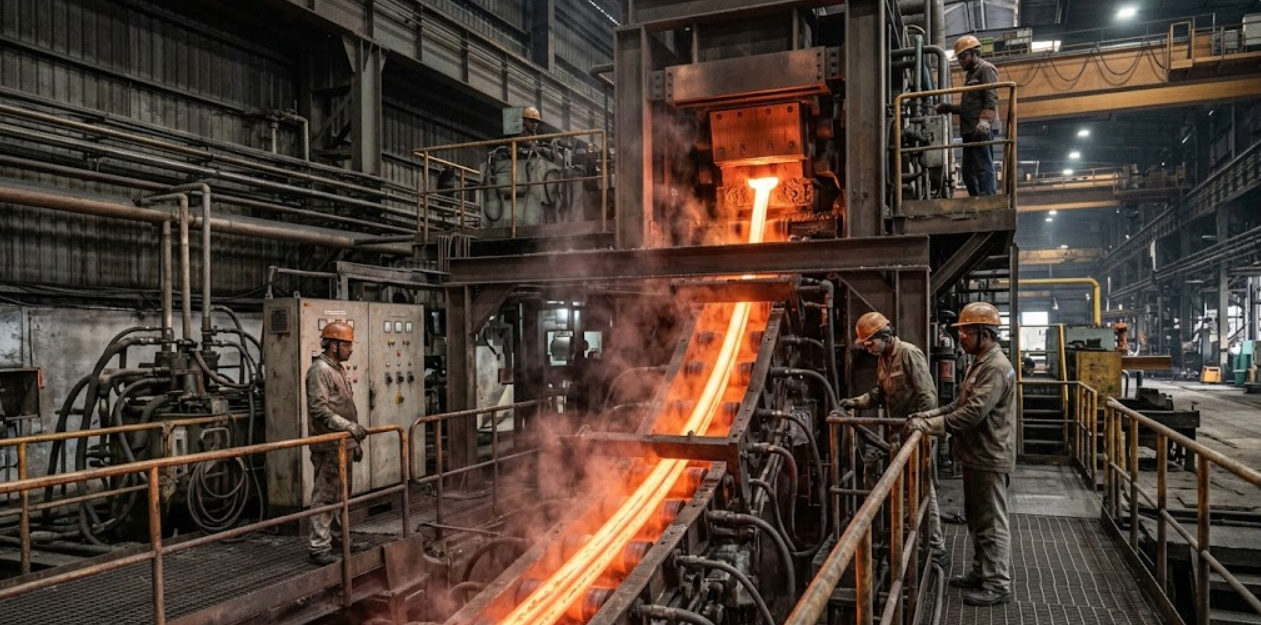
State-of-the-art manufacturing facility spread across 15 acres with integrated production units. Optimized layout ensures smooth material flow from melting to finished goods storage.
Advanced production planning system integrates demand forecasting, capacity planning, and material requirements to optimize manufacturing efficiency. Real-time scheduling ensures on-time delivery and resource optimization.
Monthly and quarterly demand analysis based on historical data, market trends, and customer orders. Accuracy: 92%
Weekly production schedules optimized for product mix, changeover time, and delivery commitments. Rolling 4-week schedule
ERP-integrated MRP system ensures timely availability of raw materials. Automated purchase requisitions based on production plan
Long-term capacity analysis identifies bottlenecks and expansion requirements. Utilization optimization across all equipment
Dynamic order sequencing based on delivery dates, customer priority, and production efficiency. Critical orders fast-tracked
Forecast Accuracy
On-Time Delivery
Capacity Utilization
Rolling Schedule
Sophisticated inventory management system optimizes working capital while ensuring material availability. Real-time tracking and ABC analysis enable efficient stock control across raw materials, WIP, and finished goods.
Premium scrap grades, high-demand finished products. Daily monitoring, tight control.
Standard scrap grades, regular products. Weekly monitoring, moderate control.
Consumables, spares, low-value items. Monthly monitoring, basic control.
Comprehensive preventive maintenance program ensures maximum equipment uptime and reliability. Systematic maintenance scheduling, spare parts management, and CMMS software have reduced breakdown downtime by 35%.
| Frequency | Activities | Equipment |
|---|---|---|
| Daily | Visual inspection, lubrication, cleaning | All critical equipment |
| Weekly | Detailed inspection, minor adjustments | Furnaces, rolling mill |
| Monthly | Component replacement, calibration | Hydraulic systems, motors |
| Quarterly | Major overhaul, predictive testing | Furnace refractory, mill rolls |
Downtime Reduction
Equipment Uptime
Monthly Maintenance Budget
Maintenance Team Size
Strategic energy management program reduces power consumption to 550 kWh/ton through efficiency measures, renewable energy integration, and continuous optimization. 12% cost reduction achieved through systematic energy initiatives.
Specific power consumption. Industry average: 650 kWh/ton
On-site solar plant supporting cleaner manufacturing operations
Energy cost savings achieved through optimization measures
Maintained through APFC panels, avoiding penalty charges
VFDs installed on all major motors for speed control and energy savings. 15% energy reduction in motor operations.
Complete plant lighting converted to LED. 60% reduction in lighting energy consumption.
Improved refractory lining, power factor correction, and optimal charging practices reduce furnace power consumption.
Leak detection and repair program. Energy-efficient compressors with heat recovery system.
Heat recovery from furnace flue gases for preheating scrap, improving thermal efficiency.
Comprehensive waste management program achieves 85% scrap recycling rate through systematic segregation, reuse initiatives, and zero-waste targets. Environmental compliance and slag utilization minimize landfill disposal.
| Waste Type | Quantity/Month | Recycling Rate |
|---|---|---|
| Metallic Scrap | 120 Tons | 100% |
| Furnace Slag | 80 Tons | 95% |
| Used Oil | 500 Liters | 80% |
| Refractory Waste | 15 Tons | 70% |
Furnace slag, a by-product of steel melting, is processed and supplied to:
Data-driven manufacturing through comprehensive KPI monitoring. Real-time dashboards track OEE, cycle time, yield rate, and quality metrics enabling proactive management and continuous improvement.
Availability: 92% � Performance: 88% � Quality: 96% = 78% OEE. World-class target: 85%
Tap-to-tap time for 15-ton furnace heat. Includes melting, tapping, and charging operations.
Finished product output vs raw material input. 8% loss in slag, scale, and crop ends.
Average daily production across 3 shifts. Peak capacity: 950 tons/day achieved.
Products meeting specifications in first attempt without rework
Products rejected by customers. Target: Below 0.2%
Products rejected during internal quality checks
Orders delivered within committed timeline
| Metric | Current | Target | Status |
|---|---|---|---|
| Equipment Uptime | 96.5% | 95% | ? |
| Capacity Utilization | 85% | 80% | ? |
| Energy Consumption | 550 kWh/ton | 600 kWh/ton | ? |
| Scrap Recycling | 85% | 80% | ? |
| Inventory Turnover | 8.5x | 8x | ? |
| Labor Productivity | 3.4 tons/person | 3 tons/person | ? |
Achieved "Best Performing Plant" award in 2023 for consistent KPI excellence across all parameters.
Systematic implementation of lean methodologies eliminates waste, improves flow, and maximizes value. 5S, Kaizen, TPM, and value stream mapping drive continuous improvement across all operations.
Continuous improvement through employee suggestions and small incremental changes. Every employee empowered to identify and implement improvements.
Visual mapping of material and information flow identifies waste and improvement opportunities. Annual VSM exercises for all product families.
| Waste Type | Examples | Countermeasures |
|---|---|---|
| Overproduction | Excess inventory | Pull system, JIT |
| Waiting | Idle time | Line balancing |
| Transportation | Material movement | Layout optimization |
| Over-processing | Unnecessary steps | Process simplification |
| Inventory | Excess stock | Inventory reduction |
| Motion | Unnecessary movement | Ergonomic design |
| Defects | Quality issues | Poka-yoke, SPC |
Proactive maintenance approach involving operators in equipment care. Eight TPM pillars implemented for maximum equipment effectiveness.
Skilled workforce of 250 employees drives manufacturing excellence. Comprehensive training programs, multi-skilling initiatives, and performance management systems ensure continuous capability development and high productivity.
Equipment operation, quality control, maintenance procedures. Hands-on training with certification.
Mandatory safety induction, refresher courses, emergency response drills. 3,500+ man-hours annually.
Quality standards, inspection techniques, problem-solving methods. Zero-defect mindset development.
Communication, teamwork, leadership programs for supervisors and managers.
Structured OJT program for new employees with mentorship and skill assessment.
Systematic cross-training program enables workforce flexibility and operational resilience. 60% of production staff trained in multiple operations.
Structured performance management system aligns individual goals with organizational objectives. KPI-based evaluation with regular feedback and recognition.
Advanced automation and digital technologies enhance manufacturing efficiency and quality. PLC systems, SCADA monitoring, and Industry 4.0 initiatives position us for future manufacturing excellence.
Siemens PLC controls for furnace operations, rolling mill, and material handling. Automated process control ensures consistency and efficiency.
Real-time monitoring of all production parameters. Centralized control room with visual dashboards for process visibility and control.
40% automation achieved in material handling, quality inspection, and process control. Continuous automation enhancement ongoing.
Digital transformation roadmap includes IoT sensors, data analytics, and smart manufacturing initiatives for competitive advantage.
PLC-controlled power regulation, temperature monitoring, automatic charging system. Optimal melting efficiency and energy consumption.
Automated mill speed control, roll gap adjustment, and cooling system. Precise dimensional control and surface finish.
CNC-controlled cutting lines with length measurement and automatic bundling. Reduced manual handling and improved accuracy.
Automated dimensional measurement systems, ultrasonic testing equipment. Consistent quality verification and data logging.
EOT cranes with semi-automated controls, conveyor systems for material movement. Reduced manual handling and safety improvement.
Virtual replica of production line for simulation, optimization, and predictive maintenance. Implementation planned by 2025.
Machine learning for quality prediction, process optimization, and demand forecasting. Pilot projects underway.
Wireless sensor network for real-time equipment monitoring, predictive maintenance, and energy management.
Big data analytics platform for production optimization, quality improvement, and decision support systems.
Collaborative robots for material handling, inspection, and packaging operations. Feasibility study in progress.